Early years
Born at Utmanzai in the Peshawar Valley to Bahram Khan, a landowner remembered for staying out of the region's feuds.
Early life & educationDigital Memorial & Archive
A life devoted to service, education and nonviolence.
1890 1988
Introduction
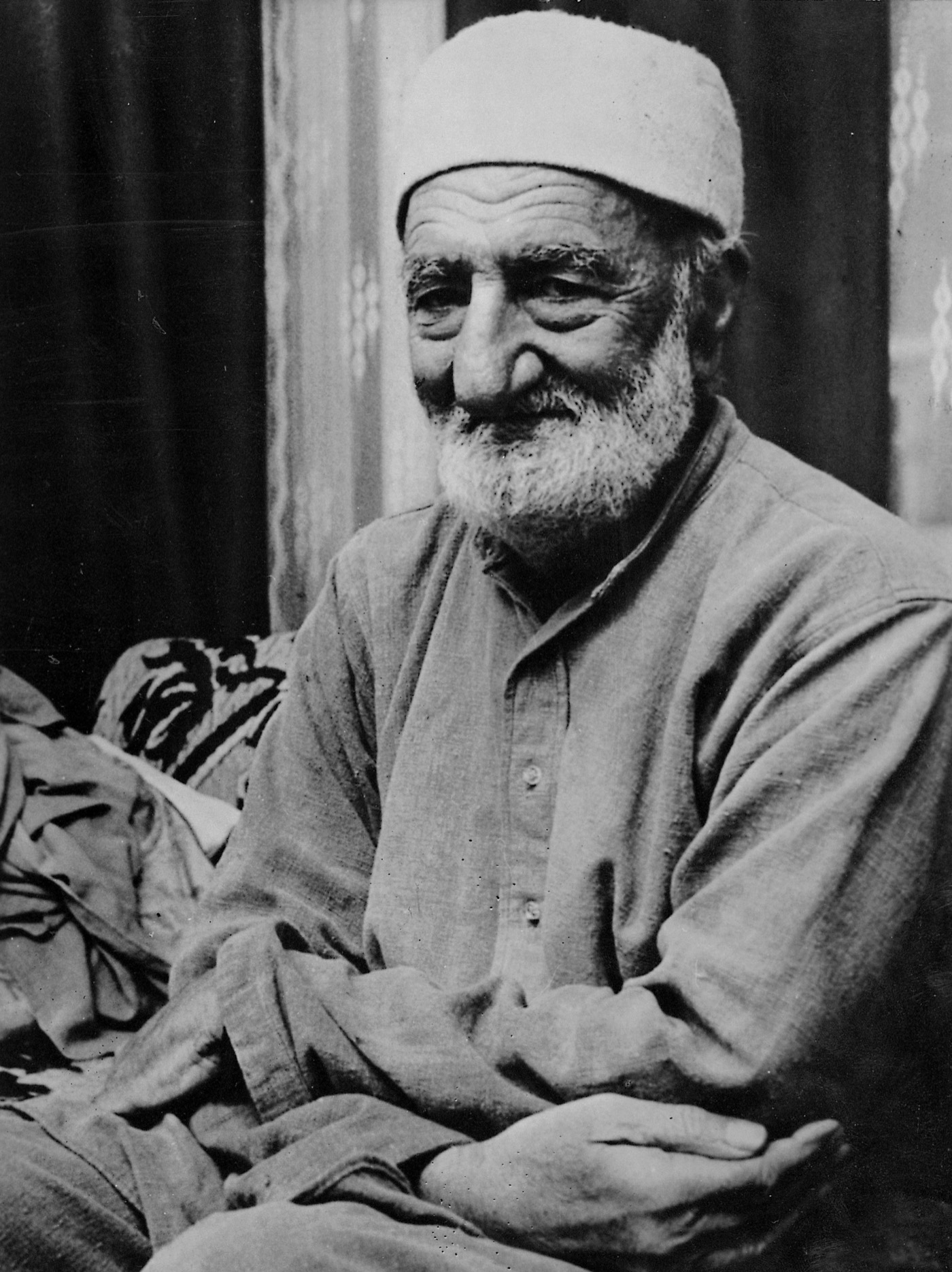
Khan Abdul Ghaffar Khan was a Pashtun reformer from the North-West Frontier of British India who did something almost no one thought possible: he organised a hundred thousand of his countrymen into an unarmed army, and held them to nonviolence in the face of a colonial state that answered them with force.
He was born in 1890 at Utmanzai, a village in the Hashtnagar country of the Peshawar Valley, into a landowning family of the Mohammadzai clan. His father, Bahram Khan, was a khan of modest means and unusual temperament — a man remembered for refusing the feuds that consumed his neighbours. The region was governed at the time under exceptional colonial law, a frontier zone administered less as a province than as a permanent security problem.
Ghaffar Khan's own answer to that condition was not politics first. It was schools. In 1910, at the age of twenty, he opened a school at Utmanzai. When the colonial authorities closed it in 1915 he kept going, walking from village to village across the settled districts of the Frontier — several hundred of them — arguing that Pashtun society was being destroyed less by the British than by its own illiteracy, its blood feuds and the exclusion of its women. It was this work, not any office, that earned him the name people gave him: Bacha Khan, and Badshah Khan — king of chiefs.
Out of that reform work grew an organisation. The Anjuman-i-Islah-ul-Afaghina, the Afghan Reform Society, was formed in 1921 to run independent schools. The Pashto monthly Pakhtun followed in 1928, giving the movement a printed voice — and giving Pashtun women a page of their own. Then, in 1929, came the Khudai Khidmatgar: the Servants of God. Its members wore uniforms, drilled in formation, carried a flag and marched to a band — and swore never to strike back.
That oath was tested almost at once. On 23 April 1930, during the Salt Satyagraha, Ghaffar Khan was arrested and unarmed crowds in Peshawar's Qissa Khwani Bazaar were fired upon by colonial troops. The Khudai Khidmatgar held to their discipline. The movement affiliated formally with the Indian National Congress in 1931, and for the next sixteen years the Frontier — a province the Muslim League expected to be its own — returned Congress governments led by Ghaffar Khan's elder brother, Dr Khan Sahib.
His friendship with Mahatma Gandhi was the most visible relationship of his public life, and the least accidental. They arrived at nonviolence by different routes — Gandhi through a Hindu and broadly ecumenical reading of ahimsa, Ghaffar Khan through the Prophet's years of endurance at Mecca — and they held to it under different pressures. British newspapers called him the Frontier Gandhi. He did not choose the name, and it obscures as much as it explains.
Partition ended the world he had built. The Khudai Khidmatgar boycotted the 1947 referendum that took the Frontier into Pakistan, having first asked, at Bannu in June of that year, for an option the ballot did not offer. In the decades that followed he was imprisoned and exiled by the state he had become a citizen of — roughly a third of his long life was spent in prison or in exile, under the British and then under successive governments of Pakistan. He died in Peshawar on 20 January 1988 and was buried, as he had asked, at Jalalabad in Afghanistan; combatants in the Afghan war declared a ceasefire so that the funeral could pass.
The Path of Service
Read across the path. Each stage opens onto a chapter of the archive.
Born at Utmanzai in the Peshawar Valley to Bahram Khan, a landowner remembered for staying out of the region's feuds.
Early life & educationAt twenty he opens a school at Utmanzai. Learning, not office, becomes the instrument of his politics.
The making of a reformerThe Anjuman-i-Islah-ul-Afaghina is founded to run independent Pashto schools; the journal Pakhtun follows in 1928.
Education before powerThe Servants of God are formed — a uniformed, drilled, unarmed body sworn to serve and never to take revenge.
The movementArrest, the Salt Satyagraha and the firing at Qissa Khwani Bazaar in Peshawar. The oath holds.
Discipline under fireAffiliation with the Indian National Congress; Congress ministries in the Frontier under his brother, Dr Khan Sahib.
Independence & PartitionThe Bannu Resolution in June; the referendum in July, boycotted. The Frontier joins Pakistan and the movement is left exposed.
1947Prison, house arrest and eight years of exile in Afghanistan — this time at the hands of the state he had become a citizen of.
After 1947India's Bharat Ratna in 1987; his death in Peshawar in January 1988 and burial at Jalalabad, under a ceasefire.
The long life of an ideaScroll sideways, or use the arrow keys ← →
Philosophy
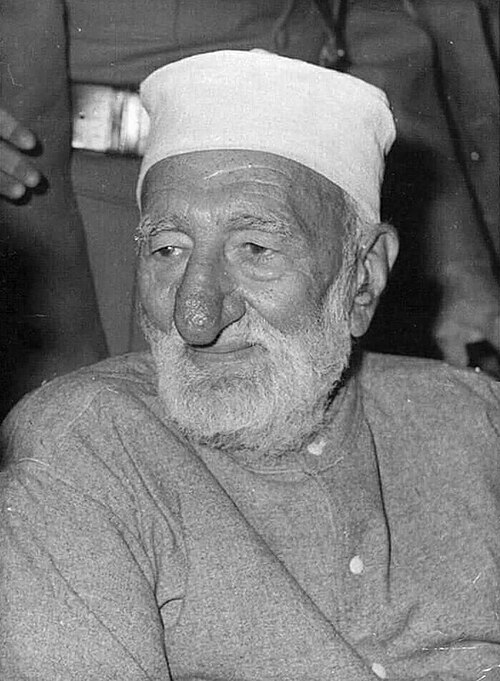
“There is nothing surprising in a Muslim or a Pathan like me subscribing to the creed of nonviolence. It is not a new creed. It was followed fourteen hundred years ago by the Prophet, all the time he was in Mecca.”Khan Abdul Ghaffar Khan Quoted in Eknath Easwaran, Nonviolent Soldier of Islam: Badshah Khan, a Man to Match His Mountains (first published 1984).
It matters that he put it that way. Ghaffar Khan was not describing a technique for embarrassing an empire; he was making a claim about where the authority for restraint came from, and he made it to an audience that had every cultural reason to reject it. Pashtun society at the time held to badal — the obligation of revenge — as a point of honour. Asking men raised in that code to be struck and not strike back was not asking them to be passive. It was asking them to be braver than the code required.
That is the distinction he kept returning to, and the one most often lost. His nonviolence was not the absence of courage but its concentration. Members of his movement were expected to accept arrest, beating and the loss of land and livelihood without retaliating — and to keep serving their villages while they did it. The oath bound them to service first: nonviolence was how the service was carried out, not a separate political programme.
He also never separated it from reform. A movement of unarmed volunteers made little sense to him unless those volunteers were also opening schools, settling feuds, cleaning village streets and arguing for the education of their sisters and daughters. Freedom from the British and freedom from illiteracy and vendetta were, in his account, the same undertaking.
The man behind the movement
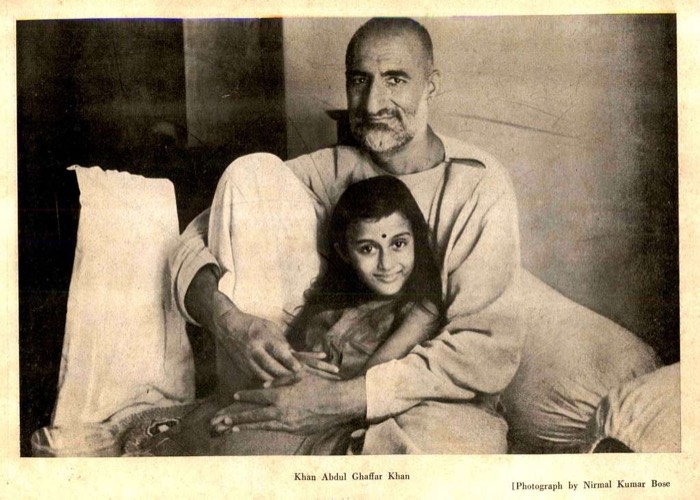
Photographs of Ghaffar Khan are consistent in a way that is itself informative. He is tall — conspicuously so beside Gandhi and Nehru — and almost always in the same plain homespun kurta and loose trousers, often barefoot, usually a step out of the centre of the frame. He accepted no ministry and held no government office at any point in his life. When the Indian National Congress offered him its presidency in 1931 he declined it.
What the record does support is a set of habits rather than a psychology. He walked and toured relentlessly, village by village, for decades. He built institutions — schools, a reform society, a journal, a volunteer corps — rather than campaigns. He asked of others exactly what he had already accepted himself: the loss of property, repeated imprisonment, and the requirement not to answer force with force.
The private cost was real and is documented. His first wife, Meharqanda, died in the influenza pandemic of 1918; his second wife, Nambata, died in 1926 after a fall in Jerusalem. He raised children who became significant in their own right — the poet and painter Ghani Khan, the political leader Wali Khan, the educationist Abdul Ali Khan, and his daughters Sardaro and Mehar Taj — across long stretches in which he was in prison and unable to be present.
Beyond that, this site does not speculate. Claims about what he privately felt, or what psychological forces shaped him, are not supported by the sources and are not made here.
The archive
Each chapter answers a different historical question. None repeats the biography.
Where he came from, what the Frontier was under colonial law, and why a young landowner's son decided that a school mattered more than a commission in the Guides.
Schools, the Afghan Reform Society, the journal Pakhtun, the campaign against blood feud, and the argument for educating Pashtun women.
How the Servants of God were organised, what they swore, why they wore red, and how a hundred thousand unarmed volunteers were held to that discipline.
A friendship and a working alliance between two men who reached the same discipline from different traditions — and did not agree about everything.
Congress ministries in the Frontier, the Bannu Resolution, a boycotted referendum, and the political consequences of 1947 for the Pashtun region.
Forty years in and out of Pakistani prisons, the Bharat Ratna, the funeral ceasefire — and what a life like this is actually evidence of.
In closing
It would be easy to file Ghaffar Khan under inspiration and move on. The harder and more useful reading is that his life is evidence — a large, awkward, well-documented piece of evidence about what is actually possible.
He demonstrated that nonviolent discipline could be sustained at scale, over decades, by a population that no one expected it from, in the least promising terrain for it. He demonstrated that such a movement could be built out of schools and village service rather than slogans. And he demonstrated the limits too: the Khudai Khidmatgar were undone in 1947 not by their own failure but by a political settlement decided elsewhere, and their leader spent the next quarter-century paying for it.
That combination — the achievement and the cost, held together honestly — is why the record still repays attention. It refuses both the triumphal version and the tragic one.
1890 — 1988
Utmanzai · Peshawar · Wardha · Bannu · Kabul · Jalalabad
The places that mark the path: the village where the first school opened, the bazaar where the oath was tested, the exile, and the grave across the border that he chose himself.